June 7, 2026
Nasdaq Futures Outlook: Key Levels and Scenarios for the Week Ahead (June 7)
1. Last Week Review
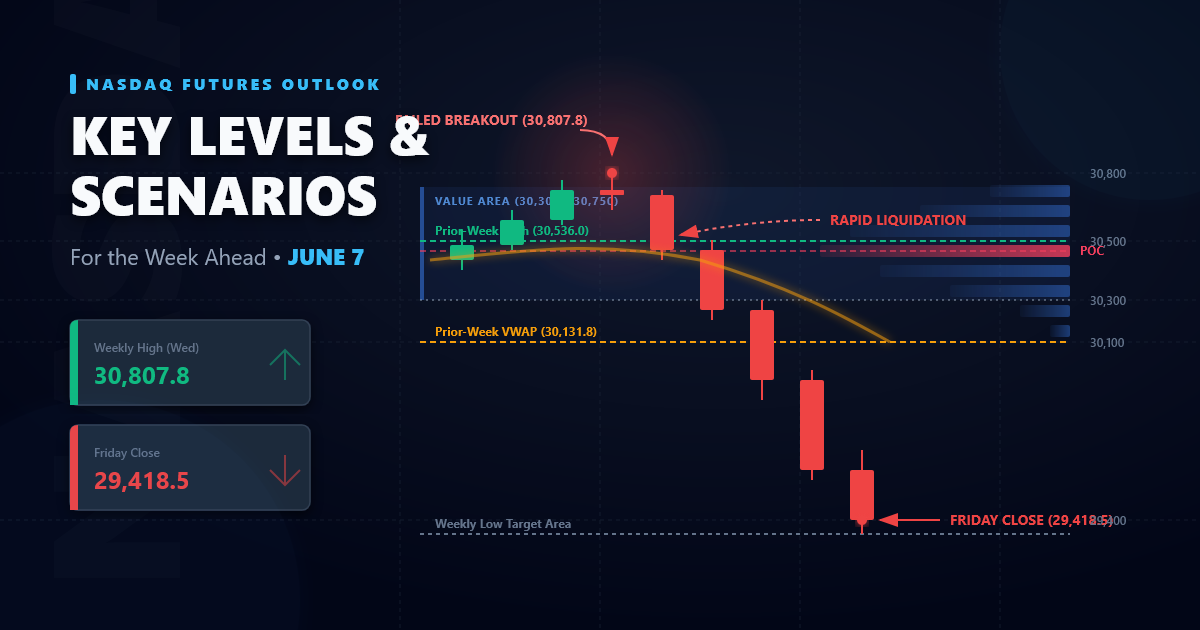
Last week‘s bullish thesis required NQ to accept above the prior-week high near 30,536.0. Price did push through that area, but the breakout failed after tagging a new weekly high at 30,807.8 on Wednesday. By Friday, NQ had lost the June open, weekly VWAP, weekly value low, prior-week VWAP, and prior-week low.
The surprise was not the pullback itself. The surprise was the speed of the rejection after buyers initially cleared the prior high. The market went from breakout attempt to liquidation profile in less than three sessions.
The prior continuation thesis was invalidated once NQ failed back below 30,300 and then lost the prior-week VWAP near 30,131.8. Friday’s close at 29,418.5 left price only 56.7 points above the weekly low and roughly 1,389 points below the weekly high.
The biggest market-structure driver was value rejection. Price spent most of the week’s volume between 30,300-30,750, then broke below that area and could not reclaim it before the cutoff.
2. Macro Catalysts
- CPI: May CPI is due Wednesday, June 10 at 8:30 a.m. ET. This is the main scheduled macro risk for NQ this week.
- PPI: May PPI follows on Thursday, June 11 at 8:30 a.m. ET. A hot CPI/PPI combination would keep pressure on long-duration growth and AI multiples.
- Fed: The Fed calendar is lighter this week, but the next FOMC meeting is June 16-17, so inflation data will feed directly into the following week’s policy setup.
- Earnings: Oracle reports fiscal Q4 results June 10 after the close. Adobe reports fiscal Q2 results June 11 after the close. Both matter for enterprise software, cloud, and AI sentiment.
- Bonds: The Fed’s latest H.15 release showed the 10-year Treasury at 4.47% and the 30-year at 4.97% as of June 4. A renewed move toward or above the recent yield highs would be a headwind for NQ.
- Dollar: Dollar strength alongside rising yields remains the risk combination to watch. DXY reclaimed the 100 area on June 5 based on available market data.
- Geopolitics: Middle East headlines remain a gap-risk variable through oil, inflation expectations, and risk appetite. Last week, markets reacted to renewed U.S.-Iran ceasefire uncertainty and oil volatility.
3. NQ Market Structure
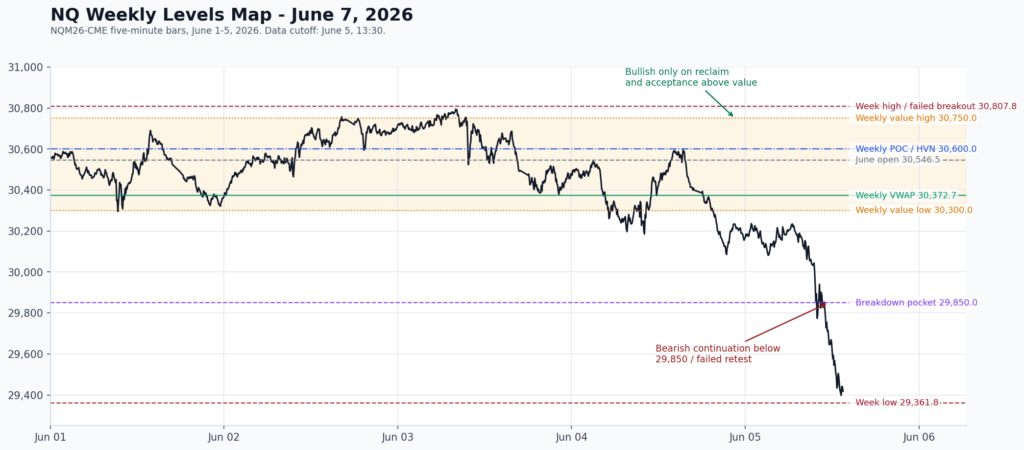
NQ is no longer in a clean upside continuation posture. The week opened at 30,546.5, made a higher high at 30,807.8, and then closed near the weekly low at 29,418.5. That is a failed breakout and trend-down finish.
The most important structural area is now 30,300-30,750, which was last week’s value area. The point of control and highest-volume node sit near 30,600. As long as price remains below 30,300, that whole value area is overhead supply rather than support.
The first downside reference is the weekly low at 29,361.8. Below that, the next larger support shelf from the May/June profile is 29,200-29,350, which also aligns with the May VWAP at 29,195.7. A failure there would open the door toward 29,000 and then 28,850-28,900.
Near-term resistance starts at 29,850, the Friday breakdown pocket. Above that, 30,052-30,131.8 is the next retest zone, followed by the more important 30,300-30,372.7 value/VWAP band.
4. Bullish Scenario
If NQ reclaims 29,850 and accepts above it, the first upside objective is a retest of 30,052-30,131.8. That would be a bounce setup, not a full bullish reversal.
The stronger bullish condition is acceptance back above 30,300-30,372.7. That would put price back inside last week’s value area and reduce the odds that Friday’s breakdown immediately continues.
For the bias to turn genuinely constructive again, NQ needs to reclaim 30,600 and hold above the weekly POC. Until then, rallies into resistance should be treated as retests of a failed breakout.
5. Bearish Scenario
If price fails below 29,850 or cannot reclaim it on an early-week retest, sellers remain in control. A break of 29,361.8 would confirm continuation below last week’s low and target 29,200-29,350.
If 29,195.7 fails, the next downside pocket is 29,000, followed by 28,850-28,900. That would mark a deeper rotation back into the prior May balance instead of a simple one-week shakeout.
The cleanest bearish setup is not chasing the low. It is a weak retest into 29,850, 30,052-30,131.8, or 30,300-30,372.7 that fails to attract buyers.
6. Key Levels
| Level | Why It Matters |
|---|---|
| 30,807.8 | Last week’s high and failed breakout extreme |
| 30,750.0 | Weekly value high |
| 30,600.0 | Weekly POC / highest-volume node |
| 30,546.5 | June open |
| 30,372.7 | Weekly VWAP |
| 30,300.0 | Weekly value low and major reclaim level |
| 30,131.8 | Prior-week VWAP |
| 30,052.2 | Thursday low / retest shelf |
| 29,850.0 | Friday breakdown pocket |
| 29,361.8 | Last week’s low |
| 29,195.7 | May VWAP |
| 29,000.0 | Psychological downside magnet |
| 28,850-28,900 | Next May profile support pocket |
Gamma zones are omitted because the supplied CSV contains price, volume, and delta data but no options-positioning data.
7. What Would Change Our Bias
The bias remains defensive while NQ is below 30,300-30,372.7. A reclaim of that band would shift the market from downside continuation risk back into rotational repair.
A sustained move above 30,600 would materially weaken the bearish case because it would put price back above the weekly POC. Acceptance above 30,750-30,807.8 would fully repair the failed-breakout structure and reopen upside continuation.
The bearish bias strengthens if 29,361.8 breaks and price cannot quickly regain it. A CPI/PPI surprise that pushes yields and the dollar higher would reinforce that downside scenario.
Sources
- BLS June 2026 release schedule
- BLS CPI release schedule
- Federal Reserve June 2026 calendar
- Federal Reserve H.15 Selected Interest Rates, June 5, 2026
- Investing.com U.S. Dollar Index historical data
- Oracle Q4 FY2026 earnings announcement
- Adobe Q2 FY2026 earnings announcement
- AP market recap, June 3, 2026
- Reuters oil/geopolitics recap via Yahoo Finance, June 5, 2026