February 1, 2026
Silver’s Parabolic Rally Ends in a Sharp Crash: Technical Analysis and Outlook
From Explosive Rally to Sharp Decline
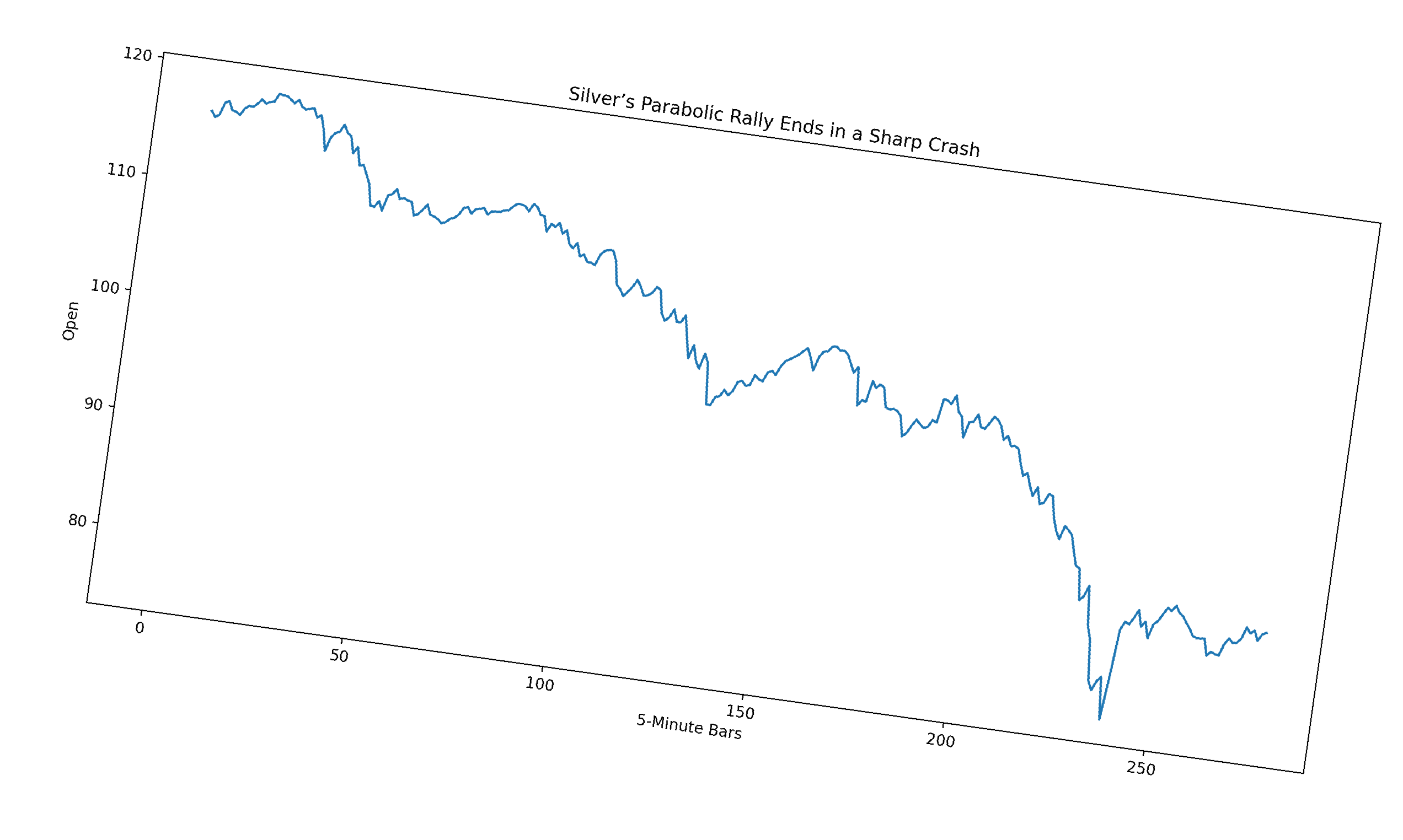
Silver has been on a breathtaking run over the past year, surging nearly 300% year-on-year and hitting an all-time high of about $120 per ounce as of January 29, 2026[1]. This meteoric rise was fueled by a perfect storm of bullish factors: a 30-million-ounce supply deficit, booming industrial demand from the AI and solar sectors, and intense speculative buying amid a weak dollar environment[2]. However, the rally abruptly reversed course late this week. In a single session on Friday, silver plunged over 25%, sinking from the $110–$120 range to the mid-$80s[3]. This 26% one-day drop – the largest in modern market history – wiped out the majority of silver’s year-to-date gains and stunned traders[4]. Gold also sold off (down ~9% Friday), but silver’s drop was uniquely severe, earning the nickname “devil’s metal” as its volatility outpaced other assets[5][6]. The swift collapse marked a stark reversal from silver’s explosive rally, and it has left traders scrambling to assess what happened and what comes next.
Technical Breakdown: Blow-Off Top and Support Breaches
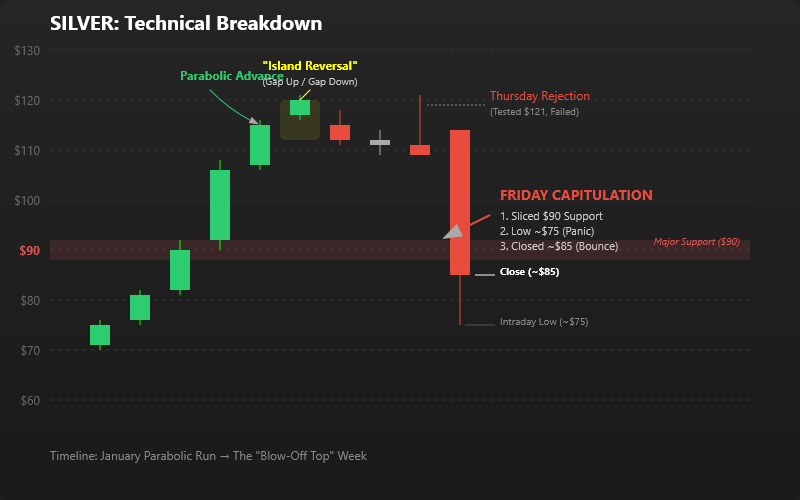
From a technical perspective, silver’s price action this week showed classic signs of a blow-off top followed by a breakdown. After a nearly vertical advance in January, the market’s momentum became unsustainable – parabolic moves have “hair triggers,” as one strategist put it[7]. Indeed, the chart formed an “island reversal” pattern early in the week: Monday’s gap-up to record highs was followed by a gap-down on Tuesday, stranding that peak and signaling bullish exhaustion. By mid-week, silver had notched a long-tailed reversal candle (after touching $121 and then retreating to close near $114 on Thursday), hinting that buyers were losing steam. The final blow came Friday when key support levels snapped – notably the ~$90 zone that had acted as support during earlier pullbacks was sliced right through. The free-fall drove prices as low as the mid-$70s intraday, well below the former breakout point around $80, before a bounce lifted silver back to an ~$85 close. In technical terms, this represents a failed breakout and trend break: the metal gave up several weeks of gains in one session, and the sharp breach of support likely triggered cascades of stop-loss selling and margin calls. On the weekly chart, the result is a huge bearish engulfing candle, an outside-week reversal that suggests the uptrend’s momentum has been broken in the short term. Traders will now be watching whether silver can stabilize above the mid-$80s support region (roughly coinciding with its mid-January consolidation) or if additional downside will test the next support around the low-$70s (the late-2025 congestion area). The speed of the drop itself is telling – it reflects a capitulation-style move often seen at the end of euphoric rallies.
Macro Drivers: Fed Jitters and Dollar Strength
This dramatic sell-off was not purely technical – it was amplified by macroeconomic catalysts that hit market sentiment. A major trigger was shifting Federal Reserve expectations. On Friday, U.S. President Trump unexpectedly nominated Kevin Warsh (a former Fed governor with a historically hawkish tilt) as the next Fed Chair, ending weeks of speculation[8][9]. The announcement eased fears that an overtly dovish, politically motivated candidate would take the helm, thereby reaffirming the Fed’s independence and reducing bets on unchecked easy money. Markets reacted swiftly: the U.S. dollar index, which had just touched a 4-year low earlier in the week, jumped nearly 1% on Friday[10]. A stronger dollar typically pressures precious metals, since a rising USD makes commodities pricier for overseas buyers. At the same time, a fresh report showed hotter-than-expected U.S. inflation at the wholesale level[11], and traders interpreted Warsh’s nomination as a sign that interest rates may stay higher for longer to combat inflation[12]. Treasury yields ticked up in response (10-year yields climbed back above 4.25%)[11]. All of this undermines one of the pillars of silver’s rally: the expectation that the Fed would soon pivot to rate cuts and allow inflation to run. In fact, while the Fed held rates steady this week, futures markets are now cautious – pricing in rate cuts only in the second half of 2026 after the new Chair is seated[13]. In short, rising real yields and a rebounding dollar flipped the script for silver’s macro backdrop, prompting heavy profit-taking. As one analyst noted, “parabolic moves” are incredibly vulnerable to any shift in psychology, and the Warsh news was the kind of catalyst that sparked a rush for the exits[7].
Unusual Volume and Speculative Froth
The rout was exacerbated by the unwinding of extremely crowded speculative positions. In the weeks leading up to the peak, investor enthusiasm for silver was feverish. Retail traders had piled into silver en masse – in fact, just days before the crash, inflows into the iShares Silver Trust (SLV) ETF hit record levels. On Monday alone, U.S. retail investors bought about $171 million of SLV, nearly double the one-day peak seen during the 2021 “silver squeeze” episode[14]. Trading activity in silver ETFs spiked to unprecedented levels: turnover in SLV ran 11 times above normal at the start of the week, even surpassing the volume surges in popular tech stocks[15]. This frenzied trading signaled a high degree of speculative froth – silver had essentially become “retail’s new favourite toy,” as Vanda Research quipped[16]. At the same time, futures markets saw record volume: on Jan. 29, silver futures trading exploded, with over 81,000 contracts changing hands (multi-year highs) as price hit the peak[17]. It wasn’t just long interest soaring – some traders were even piling into leveraged short bets (the inverse silver ETF saw volume 4× its norm) to position for a fall[18]. All of this set the stage for an outsized move. When sentiment flipped, the crowded long trade unraveled violently: Friday’s sell-off in fact registered as the largest one-day drop ever for SLV (-34%), far exceeding any daily move in the 2008 crisis or 2011 correction[19][6]. The episode underscores how liquidity can evaporate when a one-sided trade unwinds, producing a cascade of sell orders with few buyers initially. By Friday’s close, silver’s year-to-date gain was virtually erased (down to roughly +6% YTD from +62% mid-week)[20] – a staggering turnaround in the span of days. As veteran analysts pointed out, such manias and collapses are nothing new: “No one should be surprised that speculators have poured into a market that’s moving parabolic, and no one should be surprised when they leave”[21]. This week’s volume and volatility will go down in the books as a textbook example of a crowded trade imploding.
What’s Next: Support Zones, Bounce Risk, or More Downside?
Active traders are now focused on what may lie ahead for silver in the coming sessions and months. The key question: Was this a one-off flush (a temporary shock), or the start of a deeper downtrend?[22] There are a few scenarios to consider:
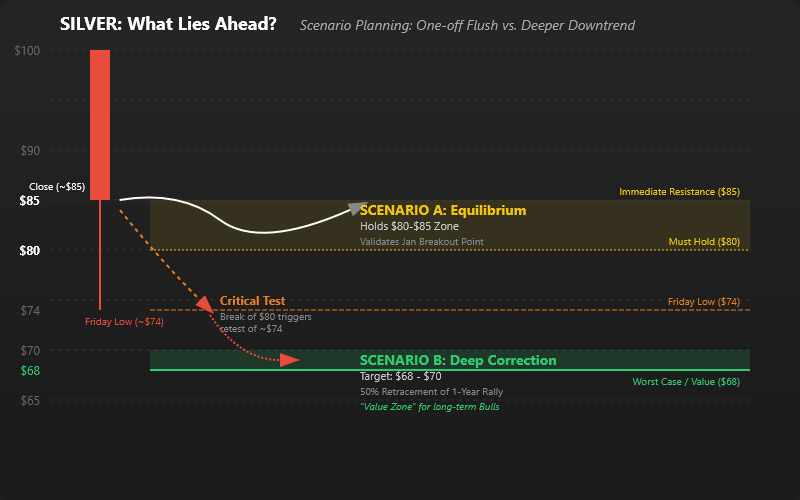
- Technical Support Zones: The first area to watch is the $80–$85 zone, which roughly corresponds to Friday’s closing level and the breakout point of the January rally. Thus far, silver has managed to hold above ~$80, a level that previously acted as resistance and could now serve as initial support. If this zone holds in the coming days with some basing price action, it would suggest the market found an equilibrium after the panic. A stronger support lies around the mid-$70s (Friday’s intraday low was about $74). Below that, the next major reference would be around $68–$70, which one prominent analyst flagged as a potential worst-case downside target if another 15–20% slide unfolds[23][24]. Notably, $68 would represent a 50% retracement of the entire one-year rally – a level some longer-term bulls might see as a value zone if reached.
- Bounce and “Dead-Cat” Rally Risk: Given the extreme short-term oversold conditions after a -26% day, a technical bounce is highly likely. Traders who got caught offside may cover shorts, and some dip-buyers may step in around support, potentially lifting silver back toward psychological levels like $100. However, any rebound could be capped by overhead resistance. The $90-$95 area (recent support now turned resistance) will be a crucial test – if silver climbs back there, prior buyers who regret not selling at higher prices might use it as an opportunity to unload, creating supply. A failure to reclaim $100 would keep the short-term bias bearish. In other words, unless silver swiftly recovers into the triple digits on strong volume (which would signal the bull trend resumption), rallies may be viewed with caution. They could prove to be “dead-cat bounces” within a new corrective phase rather than a full V-shaped recovery.
- Continuation Lower (Bearish Scenario): If silver cannot stabilize above the mid-$70s or if we see a feeble bounce that rolls over, the market may enter a deeper correction. Breaking below ~$74 (Friday’s low) would signal that no strong buyers are defending that level, opening the door to further liquidation. In that case, $70 and $68 are on the radar (as mentioned). Some analysts have even warned of a reversion toward $50 longer-term – for instance, J.P. Morgan strategists predict silver could eventually retrace to the $50 range as the bubble deflates[25]. While $50 is not a short-term target, it underscores how far prices overshot fundamentals. Historically, silver’s spectacular booms often do give back a large portion of their gains before finding a durable base. A continued unwind could also be catalyzed by factors such as further dollar strength or a delay in any Fed rate cuts (which would keep pressure on non-yielding assets). On the flip side, if macro conditions stabilize – e.g. inflation fears ebb or the Fed signals accommodation later in 2026 – that could put a floor under silver’s decline.
Looking slightly further out, it’s worth noting that despite the carnage, silver is still well above its levels from a year ago[26], and many fundamental drivers remain in play. Industrial demand for silver (e.g. for solar panels, electronics) is still robust, and the market was in supply deficit – those factors don’t vanish overnight. If anything, the shakeout might cool off the speculative excess while the longer-term bullish thesis (monetary uncertainty, inflation hedging, green energy demand) remains intact. Some institutions remain optimistic: for example, Bank of America had projected earlier this month that silver could eventually reach $135/oz or higher in 2026 in a bullish scenario[27]. Such lofty targets will likely be re-assessed, but they highlight that the structural uptrend might not be over, even if a multi-month correction or consolidation is now underway.
Bottom Line: Silver’s flash crash this week appears to be a classic case of an overheated market hitting an air-pocket. A confluence of technical exhaustion and macro headwinds triggered a torrent of long liquidation. In the near term, volatility will likely stay elevated as the market searches for a new equilibrium. Traders should keep an eye on the $80 area as a pivotal support – holding above it could invite a relief rally, whereas failing it might extend the slide. The tone has undoubtedly turned more cautious; we’ve witnessed a “brutal reversal” of a parabolic rally[22], which serves as a reminder of how quickly sentiment can flip in the silver market. Going forward, savvy traders will watch for stabilization signals (like declining volatility and steadier volumes) before confidently stepping back in. If a base builds in the weeks ahead, silver could resume its uptrend albeit in a more measured fashion, especially if catalysts like Fed easing or renewed safe-haven flows re-emerge. However, if speculative fervor remains broken, the path of least resistance in the short run may still be choppy or lower. As always with silver, expect the unexpected – this notoriously volatile metal often defies complacency. For now, risk management is key, and those trading silver will be positioning nimbly, respecting the new volatility regime while awaiting confirmation of the next directional move.
Sources: Recent market data and news from Kitco, Bloomberg, Investopedia, Economic Times, Reuters, and ETF.com[28][29][14][15][30][31] provide the basis for this analysis of silver’s latest price action and forward outlook.
Silver Crash Warnings After Parabolic Rise
-
Silver Price Hits $120 Today — Is a Silver Crash Near? Why Some Analysts Warn of Bubble-Like Dynamics
The Economic Times
Gold & Silver Selloff From Record Highs
-
Gold and Silver Prices Plunge from Record Highs—What Investors Need to Know
Investopedia -
Gold, Silver Selloff Was Inevitable After January’s Explosive Rally, But Broader Trend Remains Intact
Kitco News -
Gold and Silver Plunge as Wild Swings Rock Metals Markets
Bloomberg
Fed Chair Pick Sparks Precious Metals Rout
-
Gold, Silver ETFs Suffer Historic Collapse After Trump Taps Warsh for Fed Chair
ETF.com -
Investors Gain Some Fed Clarity With Warsh Choice, But Mull Rate Path
Reuters -
What Happened to Gold, Silver and the Dollar After the Warsh Fed Reaction?
Fortune
Retail Investors Rush Into Silver ETFs
Signs Silver Could Fall Further
-
Silver Price Crash: 3 Signs the Metal Could Be Headed for More Pain
Business Insider