July 25, 2026
Seagate After the Surge: What We Got Right and What the Market Has Already Priced In
NASDAQ: STX | July 2026 update
When we published “Seagate Technology: A Key Player in the Data and AI Storage Economy” on January 19, 2026, our thesis was straightforward: artificial intelligence would create enormous volumes of data, hyperscalers would need economical mass-capacity storage, and Seagate’s HAMR technology could translate that demand into higher revenue, margins, and cash flow.
Six months later, that thesis has worked far better—and far faster—than we anticipated.
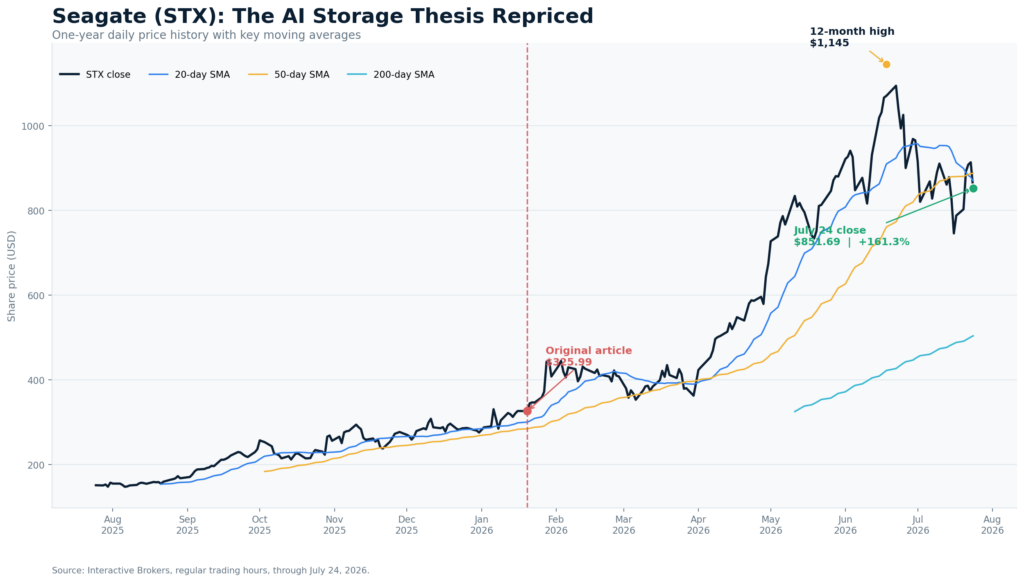
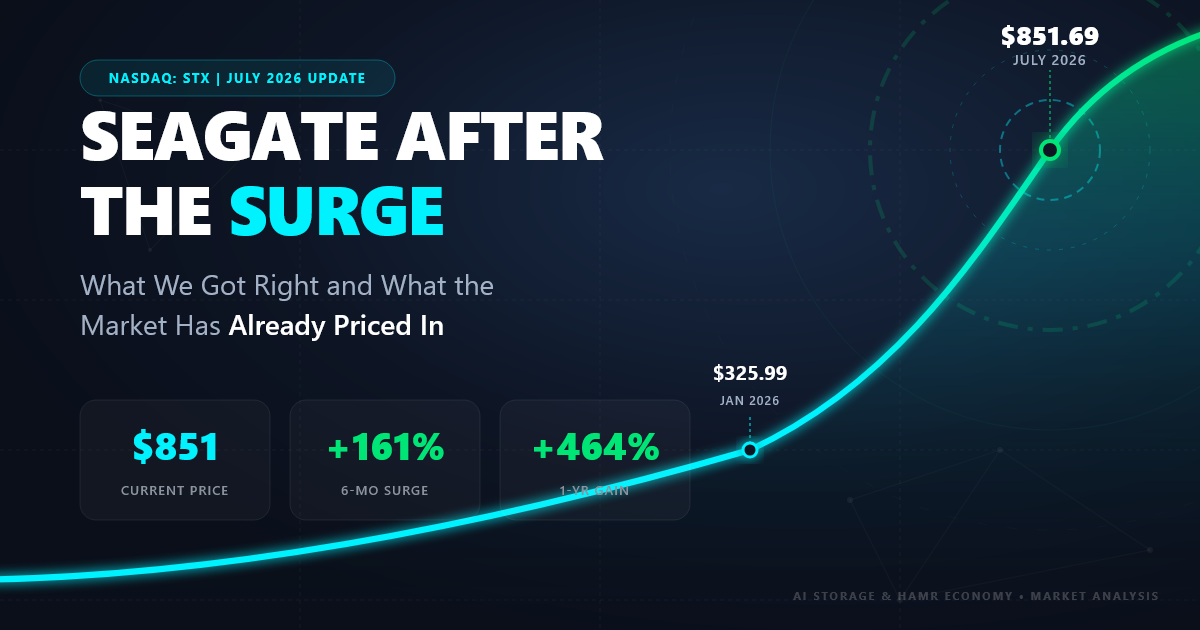
Interactive Brokers data shows that Seagate closed at $851.69 on July 24, compared with $325.99 on the first trading session following our article. That is a gain of approximately 161%. Over the full trailing year, the shares advanced roughly 464%.
The business has also delivered. Revenue, margins, earnings, and free cash flow have exceeded the expectations discussed in our original analysis. But the extraordinary share-price appreciation changes the investment question. Investors are no longer being asked whether Seagate can benefit from AI storage demand. They are being asked how much continued perfection is already reflected in an $850 stock.
What we got right
Our most important call was that AI would benefit HDD storage, not merely GPUs, high-bandwidth memory, and flash.
AI models consume fast storage while training and serving latency-sensitive workloads, but the larger AI ecosystem also creates enormous repositories of raw data, model checkpoints, video, logs, backups, and inference output. Much of that data does not need to reside on expensive flash storage. For capacity-intensive data lakes, HDD economics remain compelling.
That argument is now visible in Seagate’s numbers. In fiscal Q3 2026, data-center products generated 80% of revenue, up from 75% one year earlier. Nearline capacity shipments rose from 119.6 exabytes to 175.4 exabytes, an increase of almost 47%. Total HDD capacity shipped increased approximately 39%. Seagate specifically attributed the strength to cloud and enterprise demand, favorable pricing, and higher nearline shipments. Seagate’s SEC filing
We were also right that HDDs and SSDs should be viewed as complementary technologies. Flash dominates when speed and latency matter most. HDDs remain valuable when customers need to store exabytes at the lowest practical cost. There is no evidence yet that high-capacity SSDs are displacing Seagate’s nearline business at scale. Instead, the AI infrastructure cycle is expanding demand for both performance storage and capacity storage.
HAMR was a genuine advantage
Our original article identified heat-assisted magnetic recording, or HAMR, as Seagate’s most important competitive advantage. That was correct.
HAMR allows Seagate to increase the amount of data stored on each disk by briefly heating the recording surface with a tiny laser. Higher areal density means more terabytes per drive, fewer drives for a given amount of storage, and potentially lower power, rack-space, and hardware costs per exabyte.
In March, Seagate announced that its Mozaic 4+ platform had entered production with two leading hyperscale providers. The platform supports drives of up to 44TB, while its longer-term roadmap targets 10TB per disk and drive capacities approaching 100TB. A majority of the largest cloud-storage providers have now qualified the Mozaic platform. Seagate’s Mozaic 4+ announcement.
That is meaningful because qualification is more valuable than a laboratory demonstration. Hyperscale customers test reliability, power consumption, performance, and total cost of ownership before deploying a new storage platform across production data centers. Seagate has moved HAMR beyond the promise stage and into commercial-scale adoption.
We correctly anticipated operating leverage
The original article argued that higher-capacity products, disciplined supply, pricing, and HAMR adoption could lift Seagate’s profitability. The direction was right, but the magnitude was much greater than expected.
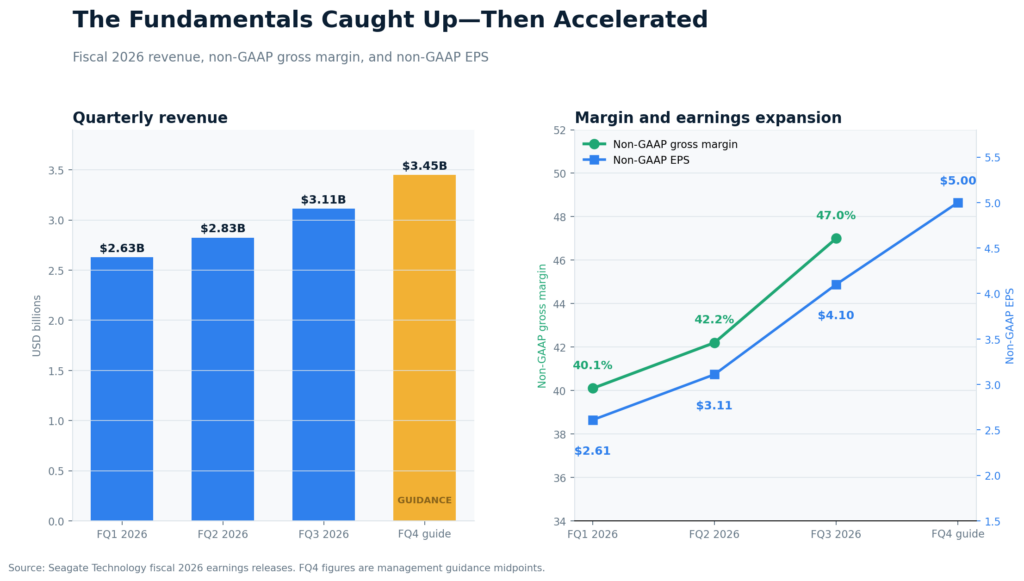
Fiscal Q3 revenue reached $3.11 billion, up 44% year over year. Non-GAAP gross margin expanded from 36.2% to 47.0%, while non-GAAP operating margin rose from 23.5% to 37.5%. Non-GAAP EPS increased from $1.90 to $4.10. The company also produced $953 million of free cash flow in a single quarter. Seagate’s fiscal Q3 results
These results show that Seagate is not simply shipping more storage. It is earning materially more on each dollar of revenue.
What we got wrong
The largest error was the pace of improvement.
Our previous analysis treated a 40% non-GAAP gross margin as a fiscal 2028 objective. Seagate reached 40.1% in fiscal Q1 2026, 42.2% in Q2, and 47.0% in Q3. Similarly, we described $3 billion in quarterly revenue as a future milestone. The company crossed that level in Q3 and guided fiscal Q4 revenue to $3.45 billion, plus or minus $100 million.
We also cited an estimated fiscal 2026 non-GAAP EPS range of approximately $11–$12. Actual results and guidance now point considerably higher. Seagate earned $2.61 in Q1, $3.11 in Q2, and $4.10 in Q3. Adding management’s $5.00 Q4 midpoint produces indicated full-year non-GAAP EPS of approximately $14.82. Fiscal Q1 results, fiscal Q2 results
In other words, we understood the operating leverage but underestimated it substantially.
The valuation warning was reasonable—but early
At approximately $326, we warned that Seagate’s 23–25 times forward earnings multiple left limited room for execution errors. The caution was understandable for a historically cyclical hardware company, but it did not anticipate how aggressively the market would reclassify Seagate as an AI infrastructure business.
The shares subsequently more than doubled.
That does not make valuation irrelevant. It means that earnings estimates rose while investors simultaneously assigned Seagate a much higher multiple. Both forces drove the stock.
At $851.69, the shares trade at roughly 57 times the indicated fiscal 2026 non-GAAP EPS of $14.82. Using the 224 million ordinary shares outstanding at the end of Q3 gives an approximate equity value of $191 billion. Against indicated fiscal 2026 revenue of around $12 billion, that is close to 16 times revenue—an extraordinary valuation for a hardware manufacturer, even one experiencing exceptional margin expansion.
For perspective, if investors eventually valued Seagate at 35 times earnings, the current price would require approximately $24.33 of annual EPS. That is about 64% above the indicated fiscal 2026 level. At 40 times earnings, the market still requires roughly $21.29 per share, or about 44% growth.
Seagate may deliver substantial earnings growth, but today’s price already assumes that fiscal 2026 is not close to peak profitability.
We overstated the simplicity of the balance sheet
The earlier article described Seagate’s balance sheet as solid. That characterization needed more nuance.
The company has made meaningful progress: it retired $641 million of debt during Q3 and generated enough free cash flow to reduce leverage while paying dividends and repurchasing shares. Nevertheless, Seagate still carried approximately $3.9 billion of debt against $1.15 billion of cash at April 3.
The balance sheet is improving rapidly, but it is not net-cash or risk-free. At this stage, debt reduction may create more value than an especially aggressive buyback at elevated share prices.
One competitive reference was already outdated
The original article discussed Western Digital as though it still combined HDD and flash operations and was considering a future separation. That was stale at publication. Western Digital completed the separation of its flash business into Sandisk in February 2025. Western Digital is now a more direct HDD-focused competitor. Western Digital’s separation announcement.
This does not invalidate Seagate’s HAMR advantage, but it changes the competitive comparison. Western Digital can now allocate its strategy and capital entirely around HDDs, while Sandisk operates separately in flash.
What the IBKR chart says
The technical picture has cooled without breaking the long-term trend.
As of July 24, Interactive Brokers data showed:
- Closing price: $851.69
- 20-day moving average: $869.65
- 50-day moving average: $887.47
- 200-day moving average: $503.66
- 14-day RSI: 48.5
- Closing-price drawdown from the peak: approximately 22%
- Intraday 12-month high: $1,145 on June 18
The shares are below their 20- and 50-day averages, indicating that short- and intermediate-term momentum has weakened. At the same time, STX remains far above its 200-day average, so the longer-term trend is still positive. An RSI near 49 is neutral rather than oversold.
This looks more like a volatile consolidation after an extreme advance than a confirmed long-term trend reversal. However, the size of the drawdown shows what happens when a highly valued stock encounters even modest changes in expectations.
The next earnings report matters more than usual
Seagate will report fiscal Q4 and full-year 2026 results after the market closes on July 28. Seagate’s earnings announcement.
The headline numbers matter, but the most important questions concern fiscal 2027:
- Can gross margin remain in the mid-to-high 40% range?
- How quickly will HAMR become the majority of nearline shipments?
- Does production remain allocated well into calendar 2027?
- Can exabyte growth continue without sacrificing pricing?
- How much of recent margin expansion is structural rather than cyclical?
- Will free cash flow prioritize debt reduction, dividends, or repurchases?
- Can fiscal 2027 earnings grow fast enough to support the present valuation?
A conventional earnings beat may not be sufficient. At approximately 57 times indicated fiscal 2026 earnings, investors will want evidence of another substantial upward revision to the earnings trajectory.
Updated conclusion
The original Seagate thesis was fundamentally correct. AI has increased the value and volume of stored data. Hyperscaler demand is strong. HDDs remain economically important for mass-capacity storage. HAMR is commercially real, and Seagate’s technology lead has translated into record margins and free cash flow.
What we underestimated was the speed and scale of the financial transformation.
The investment case is now more complicated. Seagate is a much stronger business than it was six months ago, but STX is also a much more demanding stock. At $851.69, the market is not pricing in ordinary cyclical recovery. It is pricing Seagate as a durable, high-growth AI infrastructure leader with sustained pricing power and structurally elevated margins.
Our updated view is therefore fundamentally bullish but valuation-cautious. Existing shareholders have strong reasons to remain interested, especially if HAMR adoption and fiscal 2027 guidance continue to surprise positively. New investors, however, should recognize that the margin of safety is thin. A better entry point would come from either a lower valuation or earnings estimates rising enough to catch up with the share price.
Seagate proved that an established storage company could become one of the AI era’s biggest winners. The next question is whether the business can grow quickly enough to justify how completely the market now believes that story.
Market and technical data sourced from Interactive Brokers through July 24, 2026. This article is for informational purposes and does not constitute investment advice.